
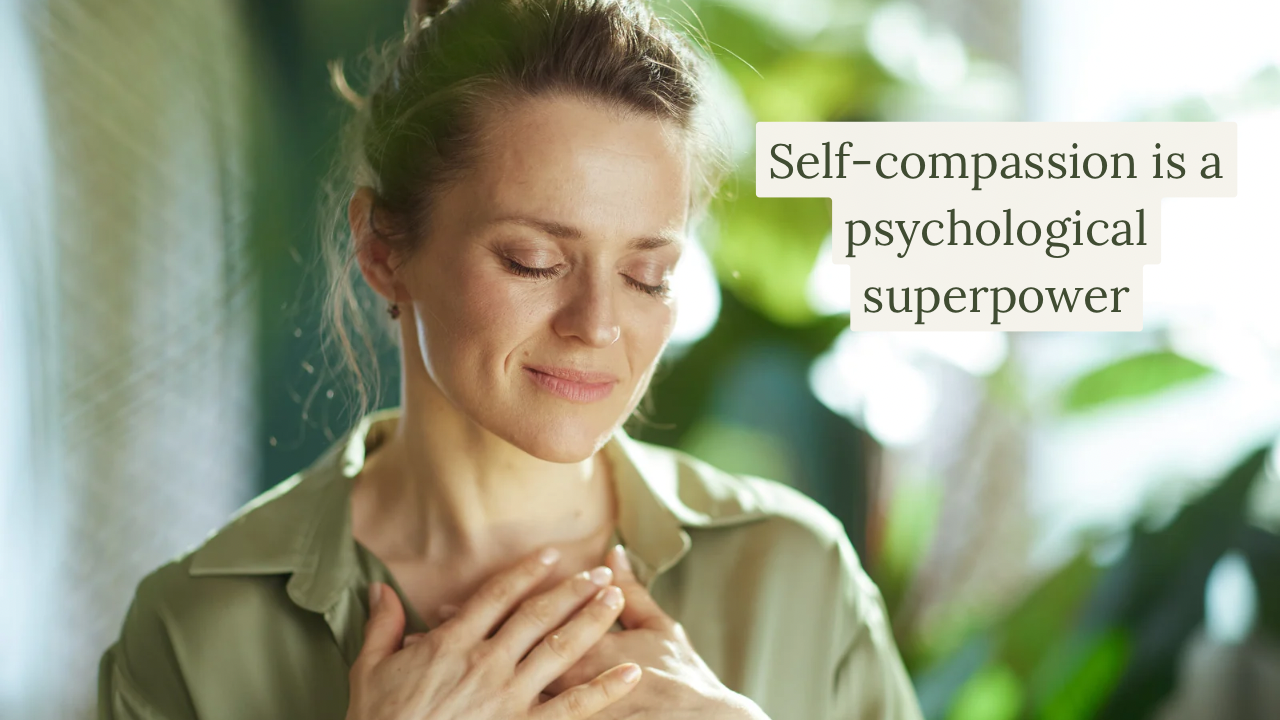
Self-Compassion: The Psychological Superpower for Anxiety Recovery
· by Kelli Ritter, PhD
Self-Compassion Is a Superpower
For years I worked as a consultant for Brené Brown's Daring Way curriculum, supporting practitioners as they worked toward certification. Almost everyone could explain shame resilience beautifully. The people who changed were the ones who stopped explaining it and started living it.
I have watched the same thing happen in anxiety recovery for the last twenty years.
When anxious feelings show up, most of us do one of two things. We fight them, or we resign ourselves to them, assuming this is simply how we are built and how we are meant to live. Both keep the signal running. Self-compassion gives the body a different signal...a safety signal.
I call self-compassion a psychological superpower because the research backs the name. It is trainable, it shows up in the body, and it is one of the missing pieces I see in people who have tried everything else.
What the Science Says
Psychologist Kristin Neff brought self-compassion into academic research in 2003. She describes three parts that work together. Self-kindness means meeting our own pain with warmth instead of judgment. Common humanity means remembering that struggle is part of being human, not proof that something is wrong with us. Mindfulness means noticing what hurts without pushing it away or getting swept up in it.
All three need to be present. Kindness without common humanity can slide into self-pity. Mindfulness without kindness can turn cold.
In my teaching I sort evidence into three tiers, established, emerging, and frontier. Here is where the self-compassion research lands.
- Established. A 2023 meta-analysis of 42 randomized trials found that self-compassion interventions reduced anxiety symptoms with a moderate effect, and the benefit held at six months in the 15 trials that followed people up. An earlier meta-analysis of 27 trials found moderate improvements in anxiety, stress, depression, and self-criticism.
- Established. Self-criticism is not the engine we think it is. In four experiments, Juliana Breines and Serena Chen found that people who responded to a personal failure with self-compassion were more motivated to improve, not less.
- Emerging. The body seems to notice. In a lab stress study, people higher in self-compassion had higher heart rate variability at rest, a marker linked to flexible stress regulation. Other work found a smaller inflammatory response to a stressful task in people higher in self-compassion.
A fair caution. Results varied widely from study to study, and some reviews flag a high risk of bias. The direction is consistent. The size of the effect is still being sorted out.
Why This Matters for Anxiety Recovery
I see anxiety as a signal, and often a gift. It tells us the body, the mind, or the soul needs something. Most of us were taught to treat that signal as a malfunction.
So a second layer arrives. What is wrong with me? Why can't I just calm down? This is meta-anxiety, overthinking about the overthinking, and harsh self-talk feeds it directly. The nervous system hears the inner critic as one more threat, and the alarm gets louder.
Self-compassion interrupts that loop in three ways.
- It ends the war with the signal. When anxious feelings are no longer the enemy, we can get curious about what they point to. That might be poor sleep, blood sugar swings, too little light, an unmet need, or an old wound.
- It gives the body a safety signal. A warm voice and a hand on the heart tell the system that nothing is attacking it. Presence over protocols. Change happens in a body that feels safe enough to change.
- It keeps people in the work. Recovery takes time and includes hard weeks. Self-criticism ends a lot of recovery journeys early. Compassion makes it possible to keep going or start again.
That last point has research behind it. In the 2023 meta-analysis, higher self-compassion at the start did not predict better outcomes, but growth in self-compassion during treatment did. You do not need to begin with it. You can build it.
Getting It in Your Bones
When I supported practitioners in the Daring Way work, one idea came up again and again. We wanted resilience in our bones. Knowing the research on shame is one thing. Staying present when shame lands in the body is another.
Today I call that embodiment. It is the difference between thinking resilience and living it.
Anxiety recovery works the same way. Plenty of people can tell you that anxious feelings are a nervous system response. They have read the books and they understand the science. And the body still braces every time the alarm goes off.
Understanding reaches the mind. Compassion has to reach the body, and that takes repetition. A hand on the heart, a slow breath, a kind sentence, again and again, until the body begins to believe it.
This is why I treat self-compassion as a necessary ingredient in anxiety recovery. Without it, insight can turn into one more reason to criticize ourselves for not being healed yet.
The Quantum Perspective
In my work, electricity comes before chemistry. Before a neurotransmitter does anything, cells are managing energy, signals, and rhythm. Mitochondria sit at the center of that. They produce most of a cell's energy, and they respond to light, food, sleep, and stress.
Through that lens, harsh self-criticism is a stress input. A body under constant threat spends its energy on defense instead of repair. Self-compassion is a safety input. When the body registers safety, more energy is available for rhythm, repair, and recovery. I think of a hand on the heart and a kind voice as signals of coherence, order in the system instead of static.
Here is where I name my confidence level. The heart rate variability findings above sit in the emerging tier. The idea that self-compassion shifts mitochondrial function or cellular coherence directly sits in the frontier tier. It is a hypothesis I find compelling and use to guide practice.
What I can say with confidence is that the practice is free, it is simple, and many people feel the difference in their bodies. That is where I start. Presence over protocols.
From Self-Compassion to Self-Love
Week 6 of my 7-week Anxiety Recovery Course is Transforming Through Radical Self-Love. It is the final key in the LIGHT Method™, and everything before it prepares the ground.
Self-compassion and self-love are close cousins. Self-compassion is what we do in a hard moment. We notice the pain, remember we are not alone in it, and respond with kindness. Self-love is the relationship that grows when we do that over and over.
Self-compassion is also the easier door. Telling someone with chronic anxiety to love themselves can land as one more thing they are failing at. Self-compassion asks for less. It is a practice of goodwill, and it does not require good feelings. We can offer it while we still dislike what we are going through. Neff argues that common humanity is what sets self-compassion apart from self-love and self-acceptance on their own.
This is also where self-love and self-care part ways. Self-care without self-love can become another performance, another list of shoulds. Self-love changes the foundation underneath the care.
In my experience, how loved and supported we feel is closely tied to how we treat ourselves. When the inner voice shifts from critic to ally, the whole system has less to defend against. Love is the medicine.
Eating to Nourish, Not Restrict
Food is one of the places we are hardest on ourselves. Many people with anxiety have been through rounds of strict plans, and every slip comes with a story about willpower.
Restriction is a stress signal for the body. Skipped meals and blood sugar swings can feel a lot like anxiety, and the self-judgment that follows adds a second hit. Nourishment is a safety signal. It tells the system that resources are coming.
The research on self-compassion and eating points the same way. In a small experiment with college women who tend to restrict, a brief self-compassion prompt reduced overeating after an indulgent food. Another study found that higher self-compassion was linked to less disordered eating, even after accounting for self-esteem. These are early-stage findings, and I place them in the emerging tier.
Here is a small practice. Before your next meal, put a hand on your belly and take three slow breaths. It is a simple way to tell the nervous system it is safe to digest.
This is the heart of my Food-Mood Anxiety Solutions course. We look at blood sugar, protein, nutrient gaps, and food timing as a circadian signal, and there is no restrictive rulebook. The course is on sale through November 20 only.
One gentle note. If food feels driven by fear or rigid rules, a practitioner who specializes in anxiety and eating concerns is the right partner, and self-compassion belongs in that work too.
Resources to Start
Easy starts, about five minutes
- The Self-Compassion Break from Kristin Neff. You acknowledge the hard moment, remember you are not alone in it, and offer yourself kindness. Her site, self-compassion.org, also has free guided practices.
- The same practice in a five-minute format at Greater Good in Action, a free Berkeley resource.
- Hand on the heart, slow breath, one kind sentence. Try it at a red light, before a meal, or when the inner critic gets loud.
For deeper personal growth
- Self-Compassion by Kristin Neff. The research and the story behind it, in one warm read.
- The Mindful Self-Compassion Workbook by Kristin Neff and Christopher Germer. It follows their eight-week Mindful Self-Compassion program and includes audio practices.
- Fierce Self-Compassion by Kristin Neff. Kindness that sets boundaries and speaks up.
- The Mindful Path to Self-Compassion by Christopher Germer. A gentle clinician's guide, especially helpful when kindness stirs up old pain.
- Brené Brown's Daring Greatly and Rising Strong, for the shame resilience side of this work.
A note on pacing. For some people, kindness at first brings old pain to the surface. Germer calls this backdraft. If that happens, go slowly, shorten the practice, and bring in a trusted practitioner. It is common, and it is not a sign of failure.
Try It This Week
Pick one moment today when the inner critic gets loud. Put a hand on your heart. Name what is hard, remember you are not the only one who has felt this, and offer yourself one kind sentence. Then do it again tomorrow. That is how it gets into the bones.
If you want support, there are three ways to go deeper.
- Food-Mood Anxiety Solutions is on sale through November 20. Nourish the nervous system, skip the rulebook.
- The Anxiety Recovery Course takes you through all seven weeks, including Week 6 on radical self-love.
- If you are a practitioner, Foundations in Anxiety Recovery Coaching is where I teach this embodied approach in full.
What does your inner voice sound like when anxious feelings show up? I would love to hear. Leave a comment or send me a message.
Sources
- Luo, X., Che, X., & Lei, Y. (2023). Self-compassion interventions and anxiety: a meta-analysis of randomized controlled studies. Journal of Contextual Behavioral Science, 30.
- Ferrari, M., et al. (2019). Self-compassion interventions and psychosocial outcomes: a meta-analysis of RCTs. Mindfulness, 10.
- Breines, J. G., & Chen, S. (2012). Self-compassion increases self-improvement motivation. Personality and Social Psychology Bulletin.
- Luo, X., Qiao, L., & Che, X. (2018). Self-compassion modulates heart rate variability and negative affect to experimentally induced stress. Mindfulness.
- Breines, J. G., et al. (2014). Self-compassion as a predictor of interleukin-6 response to acute psychosocial stress. Brain, Behavior, and Immunity, 37. Summary of related findings.
- Adams, C. E., & Leary, M. R. (2007). Promoting self-compassionate attitudes toward eating among restrictive and guilty eaters. Journal of Social and Clinical Psychology.
- Breines, J. G., et al. (2014). Self-compassion, body image, and self-reported disordered eating. Self and Identity, 13.
- Neff, K. D. The three components of self-compassion.
Join the Quantum Mental Health Community
Subscribe to receive the latest news and updates from Dr. Kelli.
We will never share or sell your information, for any reason.